As a subscriber to our newsletter, you are entitled to receive a free copy of our photography ebook on composition, which contains everything you want to know about composing your photos but were afraid to ask.
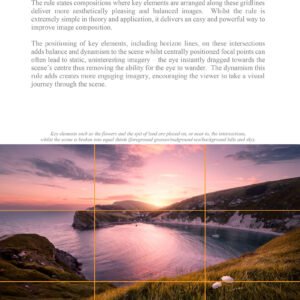
The most common rule or style, the rule of thirds, breaks an image down into thirds, both on the horizontal and vertical planes, dividing an image into 9 equal segments. The rule states compositions where key elements are arranged along these gridlines deliver more aesthetically pleasing and balanced images. Whilst the rule is extremely simple in theory and application, it delivers an easy and powerful way to improve image composition.
The positioning of key elements, including horizon lines, on these intersections adds balance and dynamism to the scene whilst centrally positioned focal points can often lead to static, uninteresting imagery – the eye instantly dragged towards the scene’s centre thus removing the ability for the eye to wander. The dynamism this rule adds creates more engaging imagery, encouraging the viewer to take a visual journey through the scene.
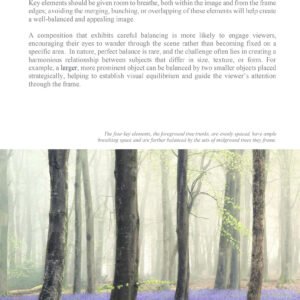
A well-balanced image utilises a scene’s real estate, emphasising key elements whilst those of a distracting nature are omitted or their impact lessened by careful positioning. Key elements should be given room to breathe, both within the image and from the frame edges; avoiding the merging, bunching, or overlapping of these elements will help create a well-balanced and appealing image.
A composition that exhibits careful balancing is more likely to engage viewers, encouraging their eyes to wander through the scene rather than becoming fixed on a specific area. In nature, perfect balance is rare, and the challenge often lies in creating a harmonious relationship between subjects that differ in size, texture, or form. For example, a larger, more prominent object can be balanced by two smaller objects placed strategically, helping to establish visual equilibrium and guide the viewer’s attention through the frame.
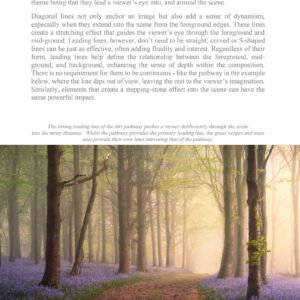
Leading lines are some of the more obvious and easily found compositional aids out there and can be horizontal, vertical, diagonal, or curved in nature. The common theme being that they lead a viewer’s eye into, and around the scene.
Diagonal lines not only anchor an image but also add a sense of dynamism, especially when they extend into the scene from the foreground edges. These lines create a stretching effect that guides the viewer’s eye through the foreground and mid-ground. Leading lines, however, don’t need to be straight; curved or S-shaped lines can be just as effective, often adding fluidity and interest. Regardless of their form, leading lines help define the relationship between the foreground, mid-ground, and background, enhancing the sense of depth within the composition. There is no requirement for them to be continuous - like the pathway in the example below, where the line dips out of view, leaving the rest to the viewer’s imagination. Similarly, elements that create a stepping-stone effect into the scene can have the same powerful impact.

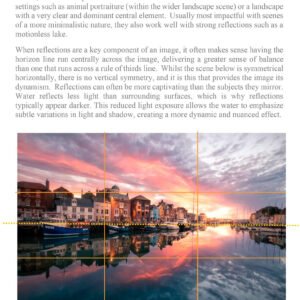
Whilst clearly deviating from the first photographic commandment, the ‘rule of thirds’, central compositions are effective and should be considered in certain settings such as animal portraiture (within the wider landscape scene) or a landscape with a very clear and dominant central element. Usually most impactful with scenes of a more minimalistic nature, they also work well with strong reflections such as a motionless lake.
When reflections are a key component of an image, it often makes sense having the horizon line run centrally across the image, delivering a greater sense of balance than one that runs across a rule of thirds line. Whilst the scene below is symmetrical horizontally, there is no vertical symmetry, and it is this that provides the image its dynamism. Reflections can often be more captivating than the subjects they mirror. Water reflects less light than surrounding surfaces, which is why reflections typically appear darker. This reduced light exposure allows the water to emphasize subtle variations in light and shadow, creating a more dynamic and nuanced effect.
Subscribe to our newsletter for regular updates on tours and workshops, the latest news and articles, and exclusive early access to new dates and special offers.